Kim Bräuner
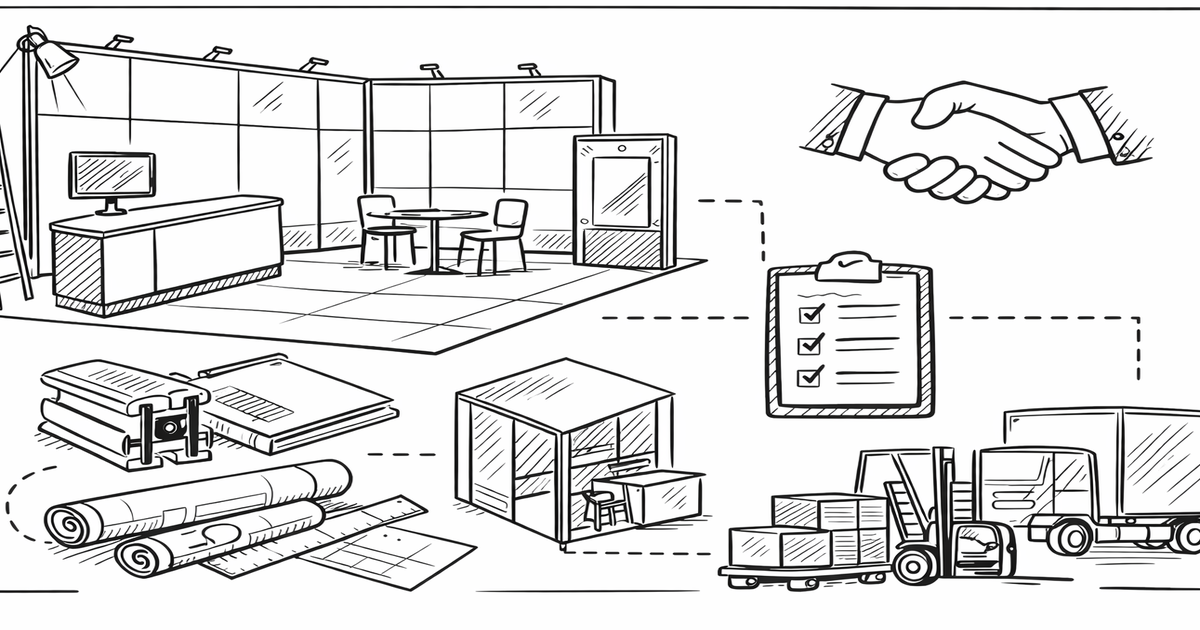
Scanex is a Danish exhibition stand builder supporting international exhibition companies that require reliable local execution in Denmark.
In cross-border exhibition projects, the design, client contact and project ownership often remain with the originating builder. Scanex performs the technical realisation — ensuring the stand is built exactly as intended.
The objective is consistency.
A stand that travels between countries must remain recognisable to returning visitors. Execution therefore follows documentation, not interpretation.
Working with Octanorm and Aluvision
Scanex works daily with Octanorm and Aluvision as modular construction systems.
Both are widely used across Europe and function as shared technical platforms between stand builders.
Because the systems are standardised, project documentation can be reused directly.
Practical effects:
- construction drawings remain valid
- mounting logic is familiar
- geometry remains identical
No conversion phase is required before production.
For international exhibition projects this significantly reduces technical clarification and scheduling risk.
Technical Continuity Across Multiple Exhibitions
Repeated exhibition stands depend on dimensional accuracy, not only graphic design.
Small deviations between builds affect perception:
- counter heights influence ergonomics
- wall alignment changes lighting behaviour
- ceiling structures alter spatial proportion
- graphic rhythm depends on exact module spacing
Using Octanorm or Aluvision with identical modular logic ensures the stand is perceived as the same installation — not a variation.
This is essential for companies exhibiting across several trade fairs annually.
OSPI Network and International Cooperation
Scanex has been part of Octanorm Service Partner International (OSPI) for more than 20 years and is the only OSPI partner in Denmark.
OSPI functions as an operational framework rather than a marketing association.
In practical terms
- drawings can be forwarded without reinterpretation
- tolerances are understood in advance
- responsibilities remain clearly separated
- installation results are predictable
Projects handled by Scanex are not limited to Octanorm-only environments.
Many partners operate primarily in Aluvision or mixed systems.
The decisive factor is technical compatibility — not exclusivity of one system.
Building Exhibition Stands in Denmark
International exhibition builders frequently require local stand construction in Denmark.
Cross-border installation teams often introduce logistical complexity:
- transport cost and timing
- venue regulations
- labour hour restrictions
- unloading windows
- hall access limitations
Using alocal exhibition stand builder reduces risk while preserving the original design.
Typical local responsibilities
- technical drawing verification
- venue coordination
- build-up and dismantling
- onsite adjustments
The originating builder keeps contact with the customer — Scanex delivers the physical stand.
Exhibitors Going Abroad
The same workflow applies when (mainly) Danish exhibitors participate internationally. Instead of transporting a full stand construction, the concept is prepared once and realised locally through partners.
Example: Naidex Birmingham
Scanex produced design and technical documentation.
A UK partner executed the installation under local conditions.
Result: A happy customer with the desired identity and function at the stand.
Planning and Technical Preparation
International exhibition reliability depends more on preparation than assembly speed.
Before build-up Scanex typically:
- reviews construction drawings
- checks venue regulations
- clarifies tolerances and materials
- prepares installation sequence
The aim is to eliminate uncertainty before installation begins.
Why Local Execution Is Used
Local execution is typically a practical decision rather than a strategic one.
Common reasons include:
- short installation windows
- transport limitations
- labour rules
- repeated events
- cost balance
The stand remains the same — only the place of assembly changes.